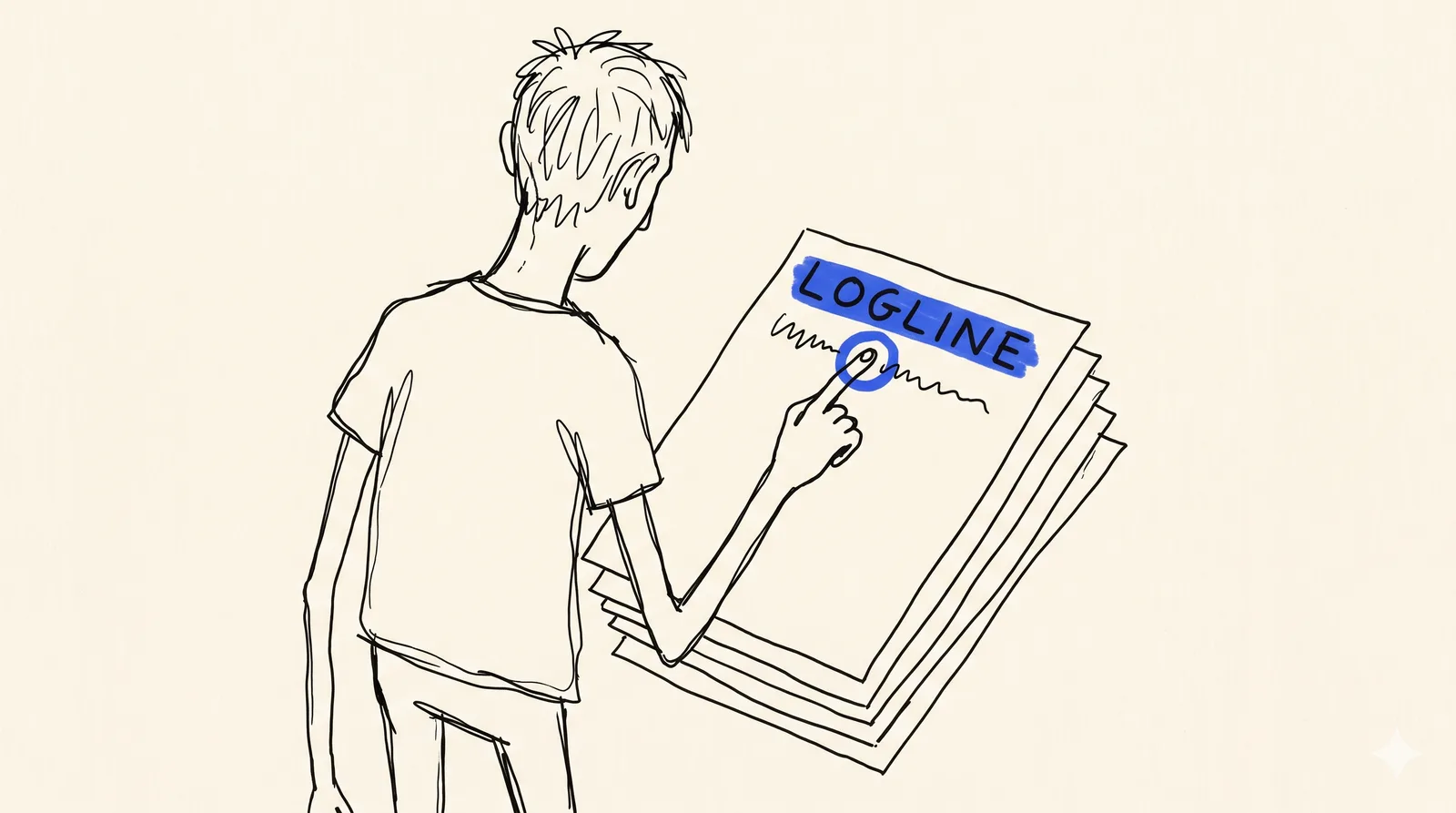
A major short programme can receive thousands of submissions for a few dozen slots. A feature strand can have hundreds or thousands of eligible films competing for a small programme. Whoever you imagine on the other side of your submission, assume they have less time than you want them to have. Selection is triage. The screener is the second step. The first step is your written package, and it gets a fast read.
Three things get read before the play button is pressed: the title, the logline, and the short synopsis. Get those three right and the rest of the package has a chance. Get them wrong and the screener does not open.
The title
A title does one job before the film loads: it gives the programmer a frame. The right frame makes the opening 30 seconds land. The wrong frame primes them to expect the wrong film, and the opening 30 seconds confuses them.
Titles that work tend to be either concrete and specific (a place, an object, a person's name, an event) or strange enough to be remembered (a phrase that does not fit standard syntax). Titles that do not work are abstract single words: Echoes, Reflections, Voices. These titles fail because every other film has them.
Test: search your title on FilmFreeway. If there are 30 other films with the same title, change yours. Programmers see a lot of Echoes.
The logline
The logline is the single most important sentence you will write about your film. It is the sentence the programmer uses to decide whether to read further, the sentence they will quote to other programmers if they champion it, and the sentence the festival will use to write the catalogue copy if it gets in.
A working logline tells me, in one sentence, three things: the protagonist, the situation, and the engine of conflict. Optionally a fourth: the tone or angle that makes it different.
Generic logline: A young woman struggles to come to terms with her past.
Specific logline: The night before her father's funeral, a 17-year-old finds the man's diary and discovers he kept a second family in the next town.
The second one is a film I would open the screener for. The first one is a category, not a story. The fix is not stylistic, it is informational. Add the specifics that make this film, not any film.
Length: aim for 25 to 40 words. Loglines longer than 50 words almost always have two ideas competing, and one of them is doing nothing. Cut.
The short synopsis
The 100-word synopsis is where most filmmakers lose the read. The temptation is to summarise the plot beat-by-beat. That is a structural plot summary, and it is exhausting to read. Programmers do not need to know what happens, they need to know what the film is doing.
A working short synopsis answers four questions in order:
- Who is the central character and what do they want?
- What is in their way?
- What is the choice or turning point at the heart of the film?
- What is this film actually about, underneath the plot?
Notice that resolution is not on that list. Do not spoil the ending in the short synopsis. The long synopsis is where the ending goes. The short version is a pitch.
Voice matters here. The synopsis is a written object that should sound like the film. If your film is funny, the synopsis is allowed to be funny. If it is unsettling, the synopsis should leave a faint chill. Programmers can tell when the synopsis voice and the film voice match. It is a small signal that you know what you have made.
The director's statement, briefly
The director's statement is read less often than the synopsis, but at a Tier 1 festival it is read, and at smaller festivals it is sometimes the deciding document. It answers one question: why this film, by you, now.
The good ones tell you something true about the filmmaker's relationship to the material that you could not have guessed from the film alone. The bad ones either tell you what is already on screen ("I wanted to explore themes of memory and loss") or perform humility ("I am honoured to share this small story"). Neither earns its space.
A reliable opening line structure: state the personal or political fact that made the film unavoidable for you. Not the theme, the fact. "My grandmother stopped speaking the year she turned 60." "I worked on a salmon farm for two summers." Specific. Yours. Then build outward.
A read-aloud test
Before you submit, read your logline, synopsis, and director's statement out loud, in that order, in one sitting. If you stumble, the prose is overwritten. If you bore yourself, the programmer will be bored too. If you sound like you are pitching to a stranger, the writing is working.
The package is the film's ambassador while you sleep. Spend an afternoon on it. It is the highest-leverage hour of writing in the whole festival process.
Frequently asked questions
What do festival programmers read first?
Three things get read before the screener is even opened: the title, the logline, and the short synopsis. Get those three right and the rest of your package has a chance. Get them wrong and the play button never gets pressed.
How long should a film logline be?
Aim for 25 to 40 words. A working logline tells the reader three things in one sentence: the protagonist, the situation, and the engine of conflict. Loglines longer than 50 words almost always have two ideas competing, so cut until one clear idea remains.
What should a short film synopsis include?
A working short synopsis answers four questions in order: who the central character is and what they want, what is in their way, what the turning point at the heart of the film is, and what the film is really about underneath the plot. Do not spoil the ending in the short version. That belongs in the long synopsis.
What makes a good director statement?
A good director statement answers one question: why this film, by you, now. The strong ones tell the reader something true about your relationship to the material that they could not have guessed from the film alone. Open with the personal or political fact that made the film unavoidable for you, then build outward.
RelatedKnow who reads your submission before you send it
Circkit's programmer and juror intelligence tells you who programmes each festival and what they tend to pick, so your materials land with the right reader. The Film Pass is a one-off £49 per film, and it never expires.