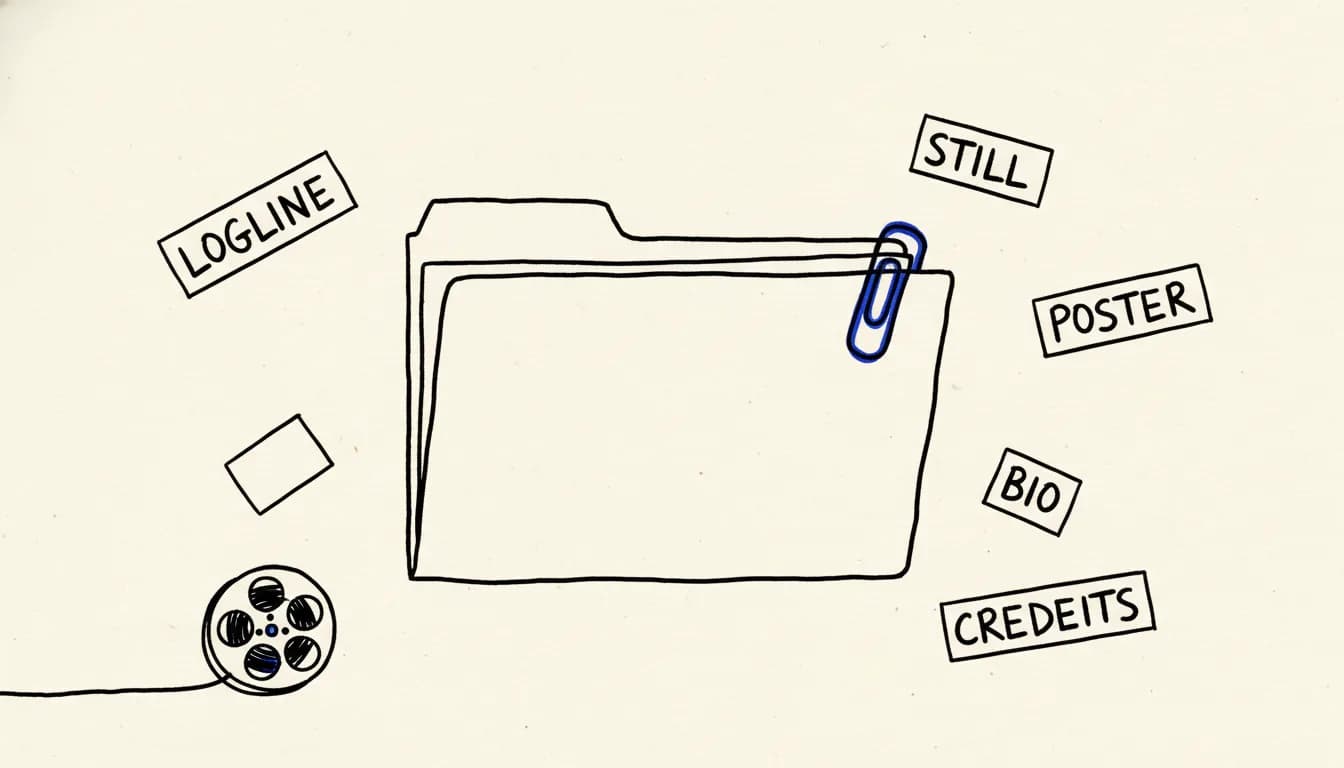
An EPK (electronic press kit) is the single asset that does the most work for your film while you are asleep. It is what a programmer forwards to a colleague when championing your screener. It is what a journalist downloads at 11 at night when writing a Sunday-morning piece. It is what a sales agent pastes into a deal memo.
Done well, it makes the case for your film without you in the room. Done badly, it is a Dropbox folder with 40 files and no narrative, which is what kills it.
What goes in (the seven assets)
- Key art / poster. One image that captures the film. Hi-res JPG and PDF. Vertical (24x36 inch standard).
- Three synopsis lengths. Logline (one sentence), short synopsis (100 to 150 words), long synopsis (300 to 400 words).
- Cast and crew bios. 100 to 150 words per person. Director, producer, writer, principal cast. Recent credits, current city, one interesting line.
- Director's statement. 150 to 300 words on why you made this film. The most-read element. More on this below.
- High-resolution stills. 6 to 10 stills, at least 300 DPI, 3000 pixels on the long edge. Mix wides, mediums, close-ups. Behind-the-scenes shots if you have them.
- Trailer link. Vimeo or YouTube, unlisted is fine. 60 to 90 seconds, the same trailer you submit to festivals.
- Press contacts. Director email, producer email, publicist email (if you have one). One line each.
What does not belong
- A casting wishlist. "We are talking to Florence Pugh" reads as desperate. Cut.
- Production budget breakdown. Belongs in a sales agent deck, not an EPK.
- Every script revision history. Programmers and journalists do not care. One synopsis is enough.
Build it during production, not after
Behind-the-scenes stills are nearly impossible to fake later. A still photographer on set for a single day costs less than re-creating production photos two months later and looks 10 times better. The same goes for cast quotes recorded during the wrap interview, B-roll for trailers, and director-on-monitor candids that journalists love.
Find the angle and build around it
Every working EPK has one editorial angle. The first feature shot in this language. The first ever short directed by a NHS junior doctor. A film about climate grief that happens to also be a love story. Find your one angle, lead with it in the director's statement, and structure the rest of the EPK to support it. Journalists need an angle. EPKs without one get put aside.
The director's statement is the most-read element
Programmers skim the synopsis. Journalists skim the bios. Both read the director's statement, because it is the one part written in a human voice. Use it. Open with one personal fact that made this film unavoidable for you, build outward to the wider question the film asks, and end with one line on what you hope it does in the world. 250 words.
Format: PDF or password-protected page, never a Dropbox link
A single downloadable PDF or a single password-protected page on your film's website. Both are linkable from a press email, both feel curated. A Dropbox folder with 40 files signals chaos. A Google Drive with restricted access signals you do not understand how journalists work (they cannot wait for you to approve).
Update it continuously
As the campaign moves, swap in new laurels, fresh press quotes, current stills from premieres. An EPK that has not been updated in six months is a dead asset. Keep one master file, push updates to the public URL.
Frequently asked questions
What is an EPK for a film?
An EPK (electronic press kit) is a single asset that makes the case for your film without you in the room. It is what a programmer forwards to a colleague, what a journalist downloads when writing a piece, and what a sales agent pastes into a deal memo. The best format is a single downloadable PDF or a single password-protected page on your film's website.
What should be included in a film EPK?
A working EPK has seven core assets: key art or poster, three synopsis lengths (logline, short, and long), cast and crew bios, a director's statement, high-resolution stills, a trailer link, and press contacts. It should also have one clear editorial angle that you lead with in the director's statement and support throughout the rest of the kit.
What should you leave out of an EPK?
Three things do not belong: a casting wishlist, a production budget breakdown, and your full script revision history. A casting wishlist reads as desperate, the budget belongs in a sales agent deck rather than an EPK, and one synopsis is enough for programmers and journalists.
How long should a director's statement be?
Around 250 words. The director's statement is the most-read element, because it is the one part written in a human voice, so use it well. Open with one personal fact that made the film unavoidable for you, build outward to the wider question the film asks, and end with one line on what you hope it does in the world.
RelatedBuild your EPK without the spreadsheet
Circkit builds a PDF press kit from your project data: poster, stills, synopses, bios, and specs.