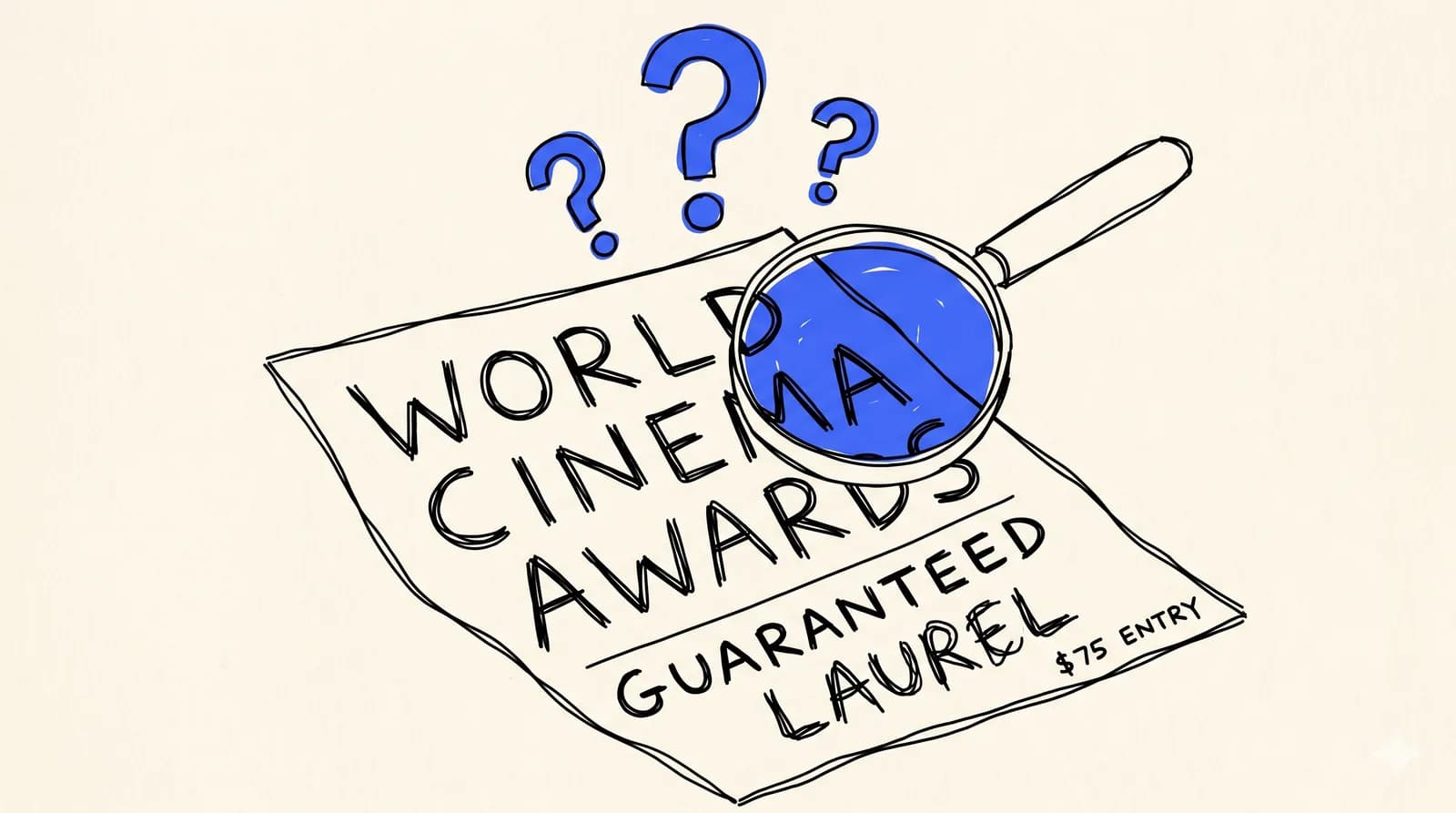
The indie film festival circuit has a scam problem. It is not a small one. In the last five years, thousands of festivals have appeared that exist for one reason: to extract submission fees and sell laurels. They have no physical screenings. They have no real jury. Their "venues" are stock photos. Their "programmers" are fake names. Filmmakers, especially first and second-time directors, lose thousands of pounds to them every year.
Both Screen Daily and The Hollywood Reporter have published investigations into the pattern. Screen Daily has gone as far as calling for a festival regulator. Nothing of the kind exists. In the meantime, filmmakers are on their own.
Here are the red flags and how to verify before paying.
The red flags
1. The name is composed entirely of generic keywords. "International Global Elite Film Awards" is a classic pattern. Real festivals have specific, rooted names, usually tied to a city, a director, an idea, or a film history. Scam festivals use interchangeable keyword soup.
2. "Awards" in the name but no real festival. Cash-grab operations are usually built around selling award certificates. They call themselves "awards" because they never intend to have a real screening. If the name emphasises awards over festival, be suspicious.
3. Monthly or weekly events. Real film festivals happen once a year. They require months of programming, venue booking, publicity, and jury selection. Any operation that claims to run "monthly" or "weekly" editions is almost certainly running an automated laurel-sale operation.
4. Online-only branding with no physical screenings. Some legitimate festivals have online components. But an "online-only" festival with a paid submission fee and no physical event is an enormous red flag. Why would a real festival programmer bother running a festival without the audience?
5. Suspicious domain TLDs. Scam operations often run on cheap TLDs, .xyz, .top, .click, .online, .info. Established festivals almost always use .com, .org, .co.uk, or country-specific TLDs. A "festival" on a .xyz domain is extremely unlikely to be legitimate.
6. No verifiable programmers, jury, or alumni. Real festivals have real humans attached to them. Try to find the programmers on LinkedIn. Try to find the jury members' actual film credits. Try to find the past selections on IMDb. If none of this checks out, the festival is probably fake.
7. Generic stock photography on the website. Open the festival's website. Reverse image search their "venue" photos. If those photos are stock images that appear on a dozen other sites, the festival almost certainly has no real venue.
8. Accepts everything. Real festivals reject the vast majority of submissions. If a festival has an acceptance rate that appears to approach 100 percent, and reviews on Trustpilot or FilmFreeway confirm this, it is a pay-to-win operation.
How to verify
Before paying any submission fee to a festival you have not heard of:
- Search for third-party coverage. Real festivals get covered by Screen Daily, IndieWire, Variety, Hollywood Reporter, or similar trade press. Scam festivals do not. A quick Google site search on those publications is an instant credibility check.
- Check FilmFreeway reviews for the specific festival. Look for detailed, specific complaints, not just low ratings. Scam festivals get detailed reviews describing fake awards ceremonies, fake juries, and pay-to-win dynamics.
- Verify the programmers by name. Do they have real film credits on IMDb? Real LinkedIn profiles? Real filmographies? If not, the "programmers" are likely fabricated.
- Check past selections. Look up three or four of the claimed past-selected films. Do they exist? Do the filmmakers mention being selected? Scam festivals often claim to have programmed films they never actually had.
- Check how long the festival has been running. A first-year festival can be legitimate, but it requires much more scrutiny. Established festivals usually have visible histories.
- Ask on r/Filmmakers. The indie filmmaker community is generally good at flagging scam operations quickly. A post asking "has anyone submitted to X festival" will usually surface honest answers within hours.
The free tool
We built a free Scam Radar for exactly this. No account, no email, no gate. Paste a festival name and URL. It checks against the red flags above and gives you a risk score. It is not a definitive verdict, no automated tool can be, but it is a useful starting point when you are about to pay £80 on a submission to a festival you have not heard of before.
Frequently asked questions
How do I know if a film festival is a scam?
Watch for a cluster of red flags rather than any single one. Generic keyword-soup names, an emphasis on selling awards over real screenings, monthly or weekly editions, online-only branding with no physical event, cheap domain TLDs, and no verifiable programmers or jury are all warning signs. A legitimate festival usually has a specific rooted name, real humans attached, and coverage in trade press like Screen Daily or Variety.
Why do scam film festivals only run online or monthly?
Real film festivals happen once a year because they require months of programming, venue booking, publicity, and jury selection. Operations that claim to run monthly or weekly editions are almost certainly running an automated laurel-sale operation. An online-only festival that charges a submission fee but has no physical event is a major red flag, since a real programmer has little reason to run a festival without an audience.
How can I verify a film festival before paying the submission fee?
Search for third-party coverage in trade press like Screen Daily, IndieWire, Variety, or Hollywood Reporter, since scam festivals rarely get covered. Check FilmFreeway reviews for specific complaints, verify the programmers have real film credits on IMDb and LinkedIn, and look up a few claimed past selections to see if they actually exist. Asking on r/Filmmakers often surfaces honest answers within hours.
Are film festivals on .xyz or .top domains legitimate?
Scam operations often run on cheap TLDs such as .xyz, .top, .click, .online, and .info. Established festivals almost always use .com, .org, .co.uk, or country-specific domains. A domain alone does not prove anything, but a festival on one of these cheap TLDs is extremely unlikely to be legitimate and warrants extra scrutiny before you pay.
Free toolCheck any festival in seconds
No account required. Paste a name, get a risk score based on known scam red flags.